Receive the package
Files enter through email or connected systems, depending on your setup. Confirm the submission route and check that expected documents are present.
 Book a Demo
Lender-built. Canadian mortgage intelligence.
Lendarex turns submitted mortgage documents and deal information into a structured review: key facts, lender-specific scoring, and findings your underwriters can investigate.
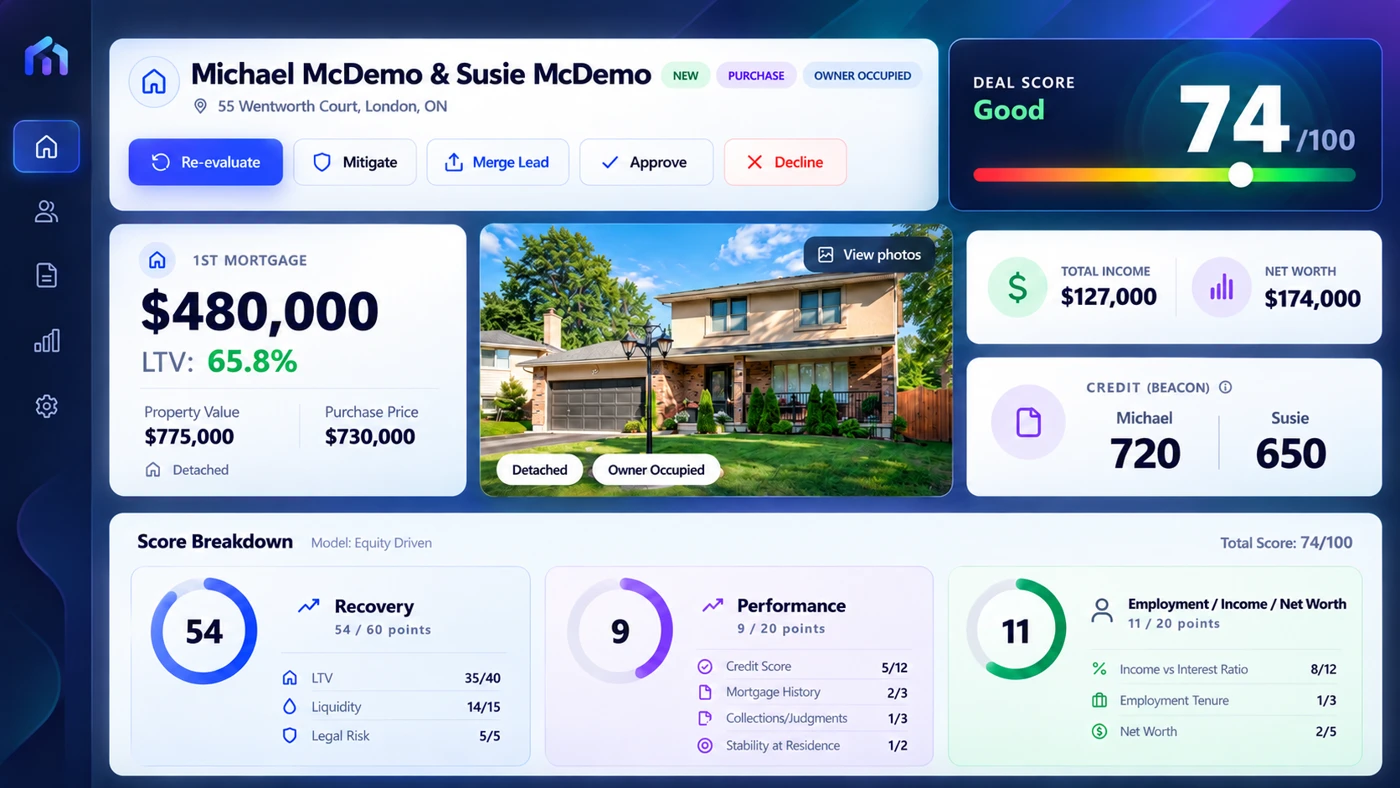
The underwriting workflow
Built for private and alternative mortgage lending teams considering the borrower, collateral, and loan structure together. Each step supports the next—not an automatic approval.
Files enter through email or connected systems, depending on your setup. Confirm the submission route and check that expected documents are present.
Available borrower, mortgage, property, income, liability, and credit information is brought into a deal profile for review.
Enabled scoring, policy checks, and document reviews surface factors, information gaps, and issues that may need closer investigation.
Your underwriter reconciles material facts with the source, evaluates exceptions, and owns the final lending rationale.
Inside the platform
See the facts and questions that matter to mortgage underwriting. The evidence you supply and the reviews enabled for your account determine the depth of analysis.
Bring applications, appraisals, credit reports, statements, purchase documents, broker notes, and supporting files into the review.
Consider valuation context, property condition, and the security position together—not just a headline loan-to-value ratio.
Organize risk factors around your lender criteria, with context for the underwriter to examine.
Surface risk flags, inconsistencies, and questions from the available evidence. AI-written reviews help focus attention; they are not final conclusions.
Configuration matters. Confirm supported document formats, lender criteria, enabled reviews, and the correction process for your organization. A populated deal profile does not establish that every document review is complete.
Designed for scrutiny
Extracted information can be incomplete or incorrect. Check material figures, the accepted value basis, existing charges, and the evidence behind a concern. Extraction is not document authentication.
A favourable score is not approval. No flags does not mean no risk. Your team still owns source verification, conditions, policy exceptions, and the final credit decision.
Evidence in practice
A current-record review of 39 TITE LTD FY2026 mortgage files found 23 high-severity broker-note findings, 30 suggested underwriting actions and 41 follow-up information requests. Counts may overlap and include some post-funding analysis; they are not confirmed defects or actions taken.
The public workflow describes applications, appraisals, credit reports, statements, purchase documents, broker notes, and supporting files. Available extraction and review depend on the document and your configuration. Confirm support for your own formats; the presence of an uploaded file does not establish that every page or field was interpreted.
Lender-specific scoring and policy checks are part of the public Lendarex workflow. Discuss the rules, thresholds, and review scope applicable to your organization rather than assuming any policy is automatically supported. Your team should validate representative results against its written mandate before relying on the configured analysis.
No. Lendarex organizes information, calculates deal metrics, and highlights items that need attention. Your team verifies source documents, applies judgment, sets conditions, and decides whether to approve or decline. AI-generated findings can be incomplete or incorrect and need human review; responsibility for the lending decision stays with the lender.
No. Lendarex cannot guarantee that every issue will be detected. Findings depend on the supplied evidence and enabled reviews, and AI may miss or misinterpret material information. Continue your normal underwriting checks; a file with no flags is not necessarily risk-free or ready for approval.
Your workflow, specifically
Use a known file to compare the analysis with your own review. Start with a synthetic or appropriately redacted package, and agree on secure handling before sharing borrower information.